
Being pioneer into the UK Cement Importation
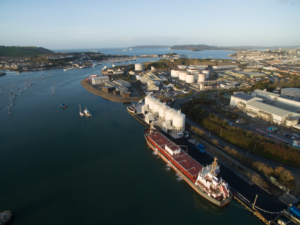
Eng. Daniele Sciuto, Area Export Manager for Euromecc, discuss the 12.000 ton storage terminal set in Plymouth early this year, which introduces a new player into the market.
Making the idea happens.
The project discussion began early in 2015, when two big family owned business in the south of UK decided to merge their efforts in order to import cement for their mutual benefits. At that time UK construction industry was going out of recession, when several cement factory had to be closed. As a consequence of that, cement prices had risen over the UK, leaving to many private businesses a lack of competitiveness along the country. That is how West Country Cement Ltd (WCC) was formed.
Looking at their own necessities, the company started looking for site, permissions, applications, and went through the entire procedure. Meanwhile, Euromecc was asked to supply preliminary drawings in order to identify layouts and specifications before moving into a deeper discussion.
The identified site looked quite narrow, although it was enough long to fit a twelve thousand ton storage, as required by WCC. Going further into discussion, once the site was secured and the preliminary planning application was approved, WCC explored different possibilities in terms of loading and unloading, considering the site was supposed to be served by self-unloading vessels carrying up to three different products, which was one of the most challenging features addressed, since the available wharf was half-suspended.
The Project.
The final project consist of a full automated cement terminal pneumatically loaded by vessel, having three load out stations fed by cement screws coming from two silos each. Every silo has a diameter of 12.500 mm, being able to store up to 2.000 ton (1.610 m3), while the total plant is able to manage up to three different products avoiding any possibility of contamination.
Loading phase is controlled by three pneumatic lines, one for each product, which run all over the site reaching the top of the silos. Here we have four independent filtering unit able to serve either a single silo or a couple of them. Switching between one silo and the other is easily managed by the control system which gives the operator the opportunity to manage it as best as possible.
Still, the control system allow the site to be un-manned, directing the operation from the main office thanks to some RFiD tags which are provided to drivers. When one of them get to site, a display shows instruction, whether he has to go to one of the three station or wait at the parking area. Afterwards he get to the station which allow him to load a certain quantity according to the information which had been pre-set on his tag, making him “independent” at site. Once he left, everything is recorded on database which are monitored from the headquarter.
Challenging the site.
The available site was quite challenging since the beginning of discussion. It is a narrow site with a quite long wharf, partially suspended. The biggest worry then was related to civil design, which required a very accurate soil investigation in order to understand the amount of job that would be involved in making the site available to afford such a big load.
Going forward with the installation, the more items arrived, the narrower site appears. This had required a big efforts in terms of erection planning and schedule, since nobody wanted the site to be either empty or overcrowded, and there was a concern of affecting the city viability by sending sixty lorries in just one shot. Therefore, lorries have been spread over six months in order to make sure everything was at site when required.
The installation sequence was agreed between Euromecc’s technical department, the engineer and the installation crew, starting from silos number 5 and 6 backward until the last two were involved. This has allowed enough storage room at site together with enough time for the civil contractor to complete the foundations.
When all of the six silos were completed, the installation crew moved forward installing all of the electrics, load-out stations, accessories and so on, while WCC completed all of the flooring and paving. Due to the wharf layout, Euromecc had to think on different anchorage solutions, which required the use of special anchors chemically fixed to the ground, an all of those area which were not depth enough.
Asking the Engineer who attended the site, Paul Finch, what has worried him the most, he says: “ “.
Conclusion.
When the first vessel was discharged, according the project schedule, it turned all of the efforts carried out into a big excitement shared between all of the people involved. Since February the Cement Terminal has been into operation with a very busy waiting.
This is another big result achieved in the UK, introducing a new cement importer in such a tough market, and making this cement terminal a flagship of Euromecc’s best engineering all over the world.
 +39 335 7156 777
 +39 335 7320 949
 +39 335 7151 919
 +39 335 6792 771
 +39 342 5439 331
 +49 6190 9376 550


