
February 2024
One finished product, plenty of manufacturing options.
Concrete rail sleepers require a very advanced quality and process control in order to avoid any weather impact or external influence on the mix design components and the manufacturing cycle. Over last decades Euromecc has supported several customers over different regions who have chosen its concrete batching plants to produce railway sleepers. Although the final product has multiple similarities across the world, the processes and the equipment used to realise them look quite different: there are skid-mounted plants like the FAST 1000S installed in France, Belgium and Polland, as well as static options in Italy, Romania and Mexico. All of them anyway have at least a few common points: there is always a planetary mixer fed by skip-hoist, whose capacity ranges between 1 m3 and 1,5 m3; and there is always an intermediate mean of transportation which brings the mixing product from the mixer to the process equipment.
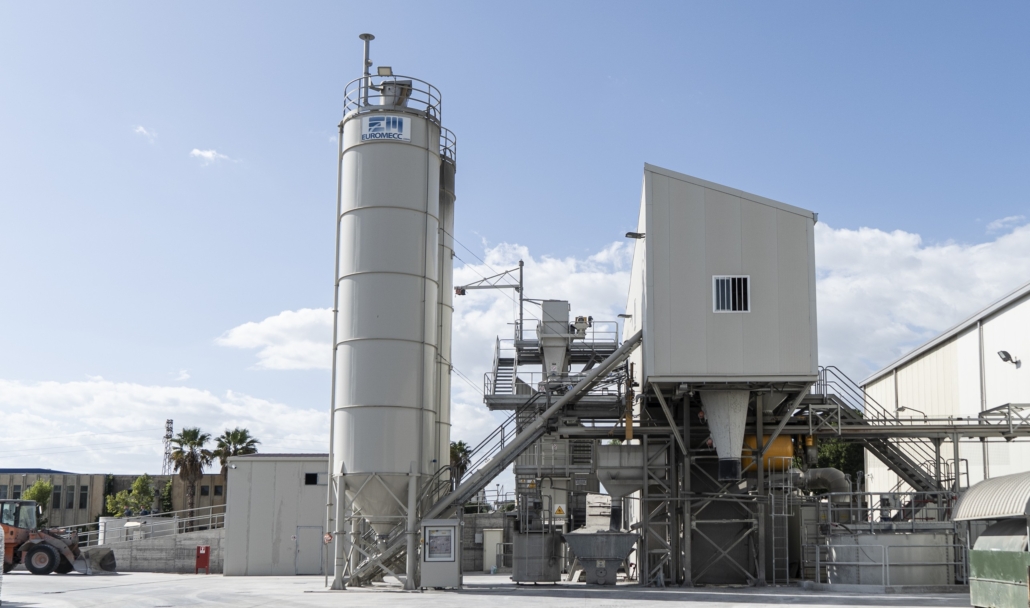
The first concrete batching plant expressively designed and installed by Euromecc to produce concrete utilised in the manufacturing of railway sleepers is six years old, located in the south of Italy. Here, after a long technical discussion with the customer, where many challenges had been brought up for attention, the specification for a new concrete plants were set. One of the main aspects taken into account was the external temperature: to achieve a consistent production in the hot mediterranean environment, it was necessary to install a chiller unit which cools aggregate and water down before they are delivered to the 1 m3 planetary mixer. Furthermore, the whole plant was cladded with insulated sandwich panels. Beside this key element, it is possible to identify a fully-automated aggregate loading system made up of an in-ground storage bin for tippers, an heavy-duty bucket elevator and a shuttle conveyor belt which feeds the six main storage compartments.
Another remarkable aspect is related to the discharge: here there are two discharge gates that feed both a flying bucket, integrated into the process to bring the concrete to the downstream production equipment, and a chute connected to a reclaiming system, able to process the batches in case they are out of tolerances.
During the following years, Euromecc has delivered several bespoke semi mobile plants model FAST 1000S to a big corporate operating in this field over multiple states. In order to standardise the fleet, and reiterate the concept from country to country, the key element has been the setup. Euromecc FAST 1000S is a skid-mounted semi mobile plant equipped with a planetary mixer of 1 m3 widely used either for construction job site either to manufacture precast products such as blocks, pavers, civil elements and so on.
Thanks to its flexibility, the buyer selected it straight to represent the core-equipment into their business model, supported by a customisation of the standard setup mainly related to the discharge chute, which has been extended to reach a low level trolley aimed to deliver the concrete to the downstream equipment. Additional components have been introduced from site to site, such as ground loading facilities with a rotating chute installed on the top, software integration with the customer control system and so on.
By looking at a different continent, it is possible to realise how, despite the distances and culture, the main principles in the industry remain the same. It is the case of Mexico where we find again a static plant with shuttle conveyor and feeding hopper. There are two aspects which significantly differ from the other installations described above: first of all there is no direct concrete transfer between the mixer and flying buckets, but there is an intermediate conveyor belt which helps in completely keeping the batching plant outdoor and secondly there are two independent planetary mixers installed on the same site that share the same aggregate batching unit. Everything else is more or less equivalent, but the clever choice of doubling up the number of mixers simply doubles up the capacity which is usually quite low based on the high mixing time required to achieve a sufficient grade of homogeneity in the mix. Furthermore, every mixer has an additional scale for silica and a dual outlet to serve truck mixers which are involved in different operations.
Last but not least, moving back to Europe there is the latest Euromecc installation in this field, due for commissioning in Q1/2024. Again it is possible to identify a completely cladded mixing unit, while the batching unit is equipped with a rain cover and the pre-arrangement for future connections with an external heating system. Again the customer planned to install the full batching plant outdoor, with a flying bucket travelling back and forward to deliver the concrete to the process equipment and reach the rest position for washing activities.
In addition, due to a very high-standardisation model adopted by the customer, Euromecc had to replace some of its standard third-parties components such as load cells with specific ones required by a strict and binding vendor list that allows the customer to centralise the management of service and spare parts.
Although there are remarkable differences between one installation and the other, every customer has taken benefit from the proposed solution either by increasing the volume of production or by reducing the amount of non-compliant batches, which has direct impact on operational costs.
In most cases the installations were related to the opening of a new business opportunity or the award of an infrastructural supply contract, considering that each plant described in the article has been producing concrete rails sleepers for the high-speed technology with a capacity ranging between 100,000 (on the small semi-mobile solutions) up to 300,000 products per year. In conclusion, the diverse range of concrete batching plant installations presented in this article, underlines Euromecc’s effort to provide solutions which meet the specific needs of its customers worldwide. Despite differences in geography, climate and operational requirements, the installations are a commitment to innovation, efficiency and quality control.
From the Mediterranean to Mexico and back to Europe, each installation reflects attention to detail and a deep understanding of the unique challenges faced by railway sleeper manufacturers. Whether it’s adapting to extreme temperatures, increasing production capacity or ensuring compliance with stringent standards, Euromecc has consistently delivered solutions that exceed expectations.
The success stories in this article demonstrate that while methods and equipment may vary, the drive for quality and efficiency remains constant.

 +39 335 7156 777
 +39 335 7320 949
 +39 335 7151 919
 +39 335 6792 771
 +39 342 5439 331
 +49 6190 9376 550


