
December 2014
Proximity vs efficiency
When Italy-based cement distibutor Cata Beton sought to develop its own cement storage and distribution terminal close to the port of Catania, Sicily, it turned to Euromecc to provide a turnkey solution. The project also involved the efficient, speedy transfer of cement shipments from the harbour direct to the terminal facility.
Cata Beton faced two main challenges when planning its new cement storage and distribution terminal. Firstly, the company needed to locate the facility close to the harbour and have good connections to the island’s infrastructure. It therefore acquired a site in Catania’s industrial area, on the outskirts of the town and just 14km from the main port.
Despite being in a highly-seismic area (due to the close proximity of Mount Etna), the main issue of the location was the soil type, defined as type D under Italy’s law (Article 3.2, DM 14 Jan 2008). This soil category defines the stratigraphic amplification coefficient, Ss, as 1.611. Together with other site information, this allowed the company to determine that seismic acceleration was 61.1 per cent more than the standard, low-seismic, type A soil.
Furthermore, as docked ships incur a high cost to remain stationed at the harbour, Cata Beton needed equipment that allowed for the fast loading of 10,000t of cement.
Cata Beton’s technical department also required a continuous discharge cycle at its main storage facility, where cement is to be discharged into trucks for distribution.
Solution
The company therefore contacted Euromecc of Italy to propose a turnkey bulk materials handling solution and cement storage and distribution facility to meet these requirements.
After assessing the field data and storage volumes required, Euromecc drafted several project proposals which it discussed with Cata Beton’s technical department.
The approved solution involves cement being discharged at the port of Catania from a self-unloading ship via a mobile
ship unloader. Cement will then be delivered to the storage and distribution facility by tanker.
Technical specifications
The mobile ship unloader comprises:
- a square cement silo able to store up to around 225t of cement
- vertical and horizontal screw conveyors that transport the cement from the silo to the discharger
- 2 x 250rn3/h dedusted telescopic
The mobile shipunloader is able to receive the cement with a maximum flow rate of 300tph, thanks to two independent discharge points — enabling Cata Beton to achieve one of its key goals of reduced unloading time. Moreover, as a mobile shipunloader was opted for, no civil works were required. In addition, its dust filter minimises dust emissions, reducing the facility’s environmental impact.
From vessel to distribution
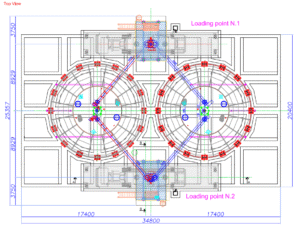
After receiving the cement, six tankers deliver the cement to the 8000t storage facility which comprises two circular bolted 3090m3 cement silos. Cement is fed to the silos using pipelines from the tankers.
Adverse site conditions, which show a seismic acceleration of 0.424g, well above the standard 0.2g, required an increase in the size and amount of windbracing, as well as reinforcement of the silo feet to minimise earthquake damage.
Both silos have a double discharge cone to continuously deliver the cement from two loading points, fed by extractor screws.
Two dedusting telescopic dischargers, similar to the ones installed on the mobile ship-unloader, feed the cement into cement trucks for final delivery of the product.
System enhancements
The terminal facility was further enhanced with an automated system that uses touchscreen and Radio-Frequency IDentification (RFID) technology. Truck drivers are able to progress from the entrance to the exit, guided by signal lights managed by the operator from the main control unit. Thanks to their RFID tags, provided by Cata Beton, drivers can access specific areas and obtain delivery tickets, eliminating the potential for error. Weight data is recorded at three on-site weighbridges from the start until the end of the process.
Furthermore, drivers are advised on the availability of loading points, which are controlled by a queue management system. At both loading points, drivers can choose one of four language options and if necessary, can communicate with the control unit thanks to several speakers installed on-site. Emergency calls to a supervisor can also be made using a GSM or Voice-over IP (VoIP) system, or via the electro-mechanical command panel.
Euromecc’s turnkey solution also included the installation of the electrical and pneumatic plant, together with the electric lighting for the entire site.
Construction in full swing
Terminal construction began in late 2013 and is well underway. Cata Beton is expected to start its trading activities by the end of the winter.

 +39 335 7156 777
 +39 335 7320 949
 +39 335 7151 919
 +39 335 6792 771
 +39 342 5439 331
 +49 6190 9376 550


