
July 2014
Malta’s Newest – Cement Player
Daniele Sciuto, Euromecc, Italy,
speaks to Ivan Carbott, Operations Director at UC Limited, about the company’s entry into the Maltese cement market.
Introduction
In 2013, Euromecc supplied a marine cement terminal to UC Limited, a growing company that wanted to establish a new cement business in Malta. The installation was commissioned after a couple of months and is now ready to begin operations and provide cement to various areas across the country.
Project overview
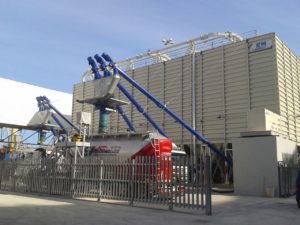
When the project began, UC Limited contracted Euromecc for the supply of a 6000 m3 environmentally friendly cement storage plant. In order to fulfil the site requirements, Euromecc provided two rectangular cement silos that were joined together to achieve the customer’s desired storage capacity. This configuration allowed UC Limited to comply with local height limits and minimised the required area for the installation. A special coating with a percentage of zinc has since been applied to enhance the reliability of the whole unit, as the silos were installed at a seaside location at the port of Valletta.
Each silo has three lines of extracting screws, which deliver the cement to the loading screws that feed the telescopic loading bellows. There are two unloading points, each one fed by three cement screws, that can reach the theoretical discharge flow rate of 250 m3/h per point; both are installed on a dedicated weighbridge. Environmental safety has been guaranteed through the installation of several filtering units on the top of the silos, which were designed according to the loading flow rate required by the customer. Furthermore, due to the loading pipeline, the need for bulk cargo vessels has been eliminated and a significant reduction in dust dispersion has been realised.
The plant features a tailor-made automation system. To enable a regular cement discharge, there are several continuous level indicators that map the exact amount of cement inside the silo. The automation system processes this data and selects the discharge gates that need to be opened for an even distribution of cement.
Setting up in Malta
Following the inauguration of the cement storage plant, Daniele Sciuto, Euromecc, met with Ivan Carbott, Operations Director at UC Limited, to discuss why the company decided to construct a cement terminal in Malta, the outcome of the installation and what UC Limited is planning to achieve in the future.
“The idea to install a cement terminal in Malta started brewing in our minds way back in 2004 when Malta joined the EU, as we knew then that it was only a matter of time before all monopolies came to an end; however, we started working on the actual project in 2011; Carbott explained. “We were aware of the fact that it was going to be no easy task to go into a market where everybody was used to having only one market player for over 30 years. Everybody thought that we were out of our minds to go ahead with such a project and such a huge investment, and to start competing against a giant who was very well established in Malta.”
During this period, the company’s initial plans involved:
- Obtaining a suitable site at the port of Valletta to erect a
- Gaining all the necessary planning and environment
- Finding a reliable cement supplier that would be interested in operating in Malta.
- Breaking into a market traditionally held by one importer/ distributor and a selected group of cement hauliers, which up to then had exclusive rights to transport all cement that came into Malta, regardless of which importer it was.
“When we look back, we are very proud to have achieved all this:’ said Carbott. “When we look ahead we see challenges — challenges that we will face with the same courage and energy we had when this whole thing started”
Terminal logistics
The bulk marine terminal, supplied by Euromecc SrI, can hold up to 8500 t of cement and employs best available technologies (BATs). Cement is brought to the terminal by self-unloading cement carriers (which unload pneumatically) — this was, and still is, a first for Malta, as cement used to be brought to the island by means of conventional bulk cargo vessels. The pneumatic unloading system is much cleaner and is environmentally friendly as no vessel holds are opened at any time and cement will never see daylight on its way from the ship to the silo. Air displaced during this silo filling process is filtered by two Euromecc filtration units, which feature BATs such as a self-cleaning mechanism for optimum filtration performance. Cement within the silo is moved by means of a fluidisation system and a number of screw conveyors that ultimately drop the cement into one of the truck loading bellows. These loading bellows have an airtight fit to the cement road tankers and any displaced air and cement dust created by this process is aspirated back into the loading bellow and filtered by the bellows’ built-in self-cleaning filtration system.
Entering the Maltese market
When asked about the company’s entrance into the Maltese market, Carbott noted the positive impact the move has had on aspects such as cement types, quality and prices. “The cement market is finally a free market in Malta and the end users are benefitting,” explained Carbott. “The cement monopoly has always dictated cement types, cement quality, service and last, but not least, the price of cement. In a nutshell we can say that after just a few weeks of us having started this operation we have shocked the market and all this has changed!’
So what does the future have in store for UC Limited’s operations in the country? “As I said, we started dispatching cement just a few weeks ago and nobody knows what the future has in store for the company’: said Carbott. “We have no expectations as by just expecting you do not achieve. Instead, we set high targets and try to get there, slowly but surely. One thing is for sure: UC Limited is composed of a very young and energetic team, all in our thirties, all of us dreamers and achievers. In the immediate future we will continue to work hard to gain further market share and we also have plans to expand and erect other silos in the near future in order to increase our storage capacity and to widen our product portfolio.”
Conclusion
Despite being faced with different site restrictions, which required a number of feasibility studies, Euromecc successfully provided a cement storage solution that completely satisfied the customer’s requirements. As a result of the strong collaboration between both companies, all targets have been achieved and the new terminal has been fully commissioned.

 +39 335 7156 777
 +39 335 7320 949
 +39 335 7151 919
 +39 335 6792 771
 +39 342 5439 331
 +49 6190 9376 550


