
May 2017
Euro-Buffer: Fast, Mobile and Profitable
The Great Recession has seen a shift from cement plants to cement terminals as cement producers sought leaner operations with reduced costs while maintaining or improving their geographical spread. Mobile transfer systems for shipunloading have played a key role in the fast unloading and loading of cement carriers.
In the last decade, the world has seen a i proliferation of cement storage facilities and an intensification of cement trade. These facilities are usually located in wharves so they are easily accessible and reduce waiting times in port.
Euromecc R&D has successfully designed a mobile transfer system which allows users to reduce the discharge time and deliver cement to a storage facility/customers.
“The increased trading of cement and the need for cement operations to become more competitive in today’s markets has resulted in a greater need to reduce costs and improve operational flexibility.
Need to reduce costs
As terminals have gained in popularity, the installation and operating costs of such cement cement facilities have increased significantly. Some of the challenges faced by cement companies include expensive rental or purchase prices of terminal sites and the need to minimise importation and operating costs to remain competitive and profitable in today’s cement trading environment.
To minimise the import cost, the sole parameter that can help to reduce costs is the time a vessel spends discharging product. In terms of operation, the user should also try to reduce the actions between the vessel and end user.
Furthermore, at some locations it is not possible to install a cement terminal due to the size of the port, which can be too small to accommodate a permanent structure.
Developing a strategy and a product
Italy-based ship unloading specialist Euromecc has extensively studied this issue and is finding ways to minimise installation and operational costs, and make a cement terminal as profitable as possible.
It found that if terminals were situated far enough away from the wharf, sales or rental costs of the site decreased, generating a saving for the cement company, particularly if the product does not need to be stored in the terminal’s (fixed) silos.
In addition, there was also the requirement for ships to leave the wharf in the shortest-possible time.
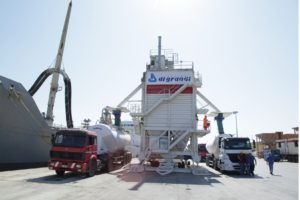
These factors led to the development of Euromecc’s Euro-buffer: a mobile silo of 170m3 capacity with a system to deliver cement via internal screws that end with two telescopic dischargers.
The Euro-buffer is fed by a self-discharging vessel and delivers the cement to two tanks simultaneously with an overall loading rate of 300tph. This allows the vessel to continue its discharge phases, even when there are no tanks being loaded, so that the buffer can be filled ensuring sufficient time between the two tanks. Furthermore, using this solution it is possible to allocate some orders during those operations to deliver the cement from the vessel to the user with the maximum profit.
The Euro–buffer in detail
The Euro-buffer is a mobile silo based on wheels with a hooking point at the base frame that does not require any dedicated foundation works. This allows for easy positioning prior to discharging without affecting the dock viability. From stand-by/parking to operation there are only a few steps, which can be executed in a very short time. Once it is positioned, four hydraulic pistons allow the lifting and stabilisation of the equipment for the working phase. The silo has a footprint of nearly 87m2. Its vertical walls are made of prebended steel panels which enhance its rigidity and increase overall capacity to 170m3.
The silo has a twin discharge cone, properly fluidised by a pneumatic plant which delivers the cement to the extraction system. This system consists of two horizontal and two vertical screws (one for each loading station). The material flows out of the screws and enters two dedusted bellowjets, which avoids dust emissions and allows the tanks to load.
In terms of filling, the silos has a single inlet to connect the self-unloading vessel. Based on standard values, a filter has been installed on the top, with a filtering surface of 90m’ , although its capacity can be upgraded accordingly. On its side is an electromechanical panel which allows for the easy management of operations.
Case study: Italian installation
The Euro-buffer has been installed at a few different sites and performance monitoring helps to better understand the savings it can bring to a cement import/ export operation. In particular, savings can be achieved due to the positioning of the tanker. As an example, Table 1 shows the Euro-Buffer’s performance data at an installation in Italy. While the customer was not able to handle two discharge stations simultaneously due to the vessel’s capacity, a significant amount of time was saved nonetheless. This amounted to just under 8.5h per vessel, ie a full working day under normal conditions.
This saving was primarily achieved by avoiding the need for the vessel discharge to halt between one tanker and the other and allowing it to continue its operation in any condition. The storage capacity helps to hold the discharged cement while the tanker is positioning under the bellowjet, which then is able to run with a higher discharge rate emptying at the same time the storage for the next cycle.
In addition, the higher capacity allows trucks to be delivered further (even to the customer’s sites if any order was collected at that time) since they can be filled three minutes faster using the 150tph bellowjet capacity rather than using the 120tph vessel capacity.
Adapting to a different game
The increased trading of cement and the need for cement operations to become more competitive in today’s markets has resulted in a greater need to reduce costs and improve operational flexibility. Faster and more mobile solutions such as the Euro-Buffer help cement producers and traders supply customers in a more profitable way, therefore having a more positive effect on a company’s bottom line.

 +39 335 7156 777
 +39 335 7320 949
 +39 335 7151 919
 +39 335 6792 771
 +39 342 5439 331
 +49 6190 9376 550


