
Delivering Cement through the ice
Daniele Sciuto, Euromecc s.r.l., introduces a cement
terminal project that Euromecc has carried out in
Murmansk, in the far north of Russia.
Overview
In mid-2014 Euromecc was awarded a tender related to the supply of a 5400 m3 (approximately 7200 t assuming a cement bulk density equal to 1.33 t/m3) cement storage terminal to be installed in Murmansk, one of the coldest regions in Russia. It is known for its severe climate, which is harsh and unstable, with abundant precipitation throughout the year, making it one of the most challenging places to install such a project. The design process required a non-standard approach, due to the extreme working temperature of the site, which can reach -37°C in winter and 20°C in summer, stressing the entire structure to a critical level. In addition, cement has to be preserved in order to be properly stocked, which means that all components and materials have to be designed according to the lowest temperature. This represents a special condition for most of the mechanical and electrical items.
General layout of the project
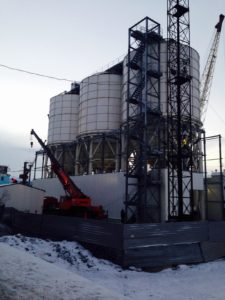
The cement terminal is made up of three independent cement silos of 1800 m3 each, with an internal diameter of 12.5 m, which are installed on a carrying structure in order to allow cement tankers to drive underneath the discharge. This structure has been designed and built to optimise the columns. There are only eight pillars to allow cement tankers to drive underneath the cones, whereas they usually have 16 columns, which are still present in the upper part of the carrying structure.
There is one loading station with 150 tph capacity, located under the mid-silo, which receives the material coming from all of the three silos via an air slide system. With this system, operations are quite fast, with a charging cycle of 12 min. per tanker. The filling phase is addressed to the two independent pipelines that will be connected directly to the vessel. The reason for having two filling pipelines is related to the possibility of importing two different products as well as the intent to double up the filling capacity with a consequent reduction in operation time. The 15° inclined conical found makes the discharge almost flat for special purpose. In fact, in this way the output capacity is constant. In addition to correct cement handling, a complex fluidisation system has been installed inside the cone, split into five sectors each working separately.
The project has been designed to meet environmental requirements, focusing on both dust emissions and noise levels. Thus, several filtering units have been designed and located on the roof and under the cone. The whole area has been housed in order to let the devices operate within their functional temperature range.
The temperature challenge
Being at -37°C is not a common situation, and it can easily be understood the kind of consequences which can arise from the use of improper components or materials. Thus, everything has been adjusted in order to become suitable to that hard working condition.
The first change involved is related to the quality of the steel. In fact, temperatures below -15°C have direct consequences on the material resilience, which decreases significantly, making the material unusable and exposing the structure to a collapse risk. Therefore, the design team was obliged to apply more conservative coefficient into the calculus to meet the Russian Standard, in particular the SNIP 20.13330.2011 for the ‘Loads and Actions’ and the SNIP 16.13330.2011 for the ‘Steel Structure.’ Thanks to this approach, the standard S235 steel, which could not resist to the extreme weather condition, was replaced with the more appropriate S355 one, while the structural category JR was increased to J2, according to the calculus reports carried out.
Secondly, each component was verified, to find out that all of them would affect the durability of the plant without adequate maintenance and service.
Although following the general layout of those on the roof, the filters installed under the discharge cones are very different. According to the working range of the bellojet, which cannot operate at -37°C, it was decided to opt for a non-filtered unit and install a proper filter at the discharge cone level. This solution prevents the use of the bellojet fan, which can easily become frozen, compromising the correct flow of the cement, as soon as the temperature drops below -15°C, despite keeping the dust emission level within the acceptable values. Instead, for the roof, a filter with frontal extraction was chosen, covered by an insulated structure in order to reduce the maximum plant height.
All the components, such as pneumatic valves, joints, flanges, bolts and so on, were chosen by focusing on the working temperature as the most important requirement, using special material that can resist thermal stress.
Finally, the silos, carrying structure, all the filters and the pipelines were upgraded with a special coating. This helps prevent the damage caused by the plant’s coastal proximity – the combination of the extreme temperature and the high humidity rate.
Operations
Such a complex project in a harsh region requires exceptional operations design and management. Murmansk is located in a subarctic zone above the Arctic Circle, with long periods of continuous daylight or total darkness. These limitations were taken into account in order to complete the installation within the agreed terms, and for this reason all the operations were designed with a severe and efficient project management plan, which has been a crucial part of the entire project from the very beginning. One of the biggest operative limitations that influenced the structural design and assembly was the usage of only a single 100 t crane to reduce the cost. Thus, the structure had to be very light and modular, split into small pieces, in order to be easily assembled in a very short time before the arrival of the harsh winter. In fact, completion was expected by the end of 2015 and thanks to the Euromecc knowhow, its solid experience and a strong planning process, this was achieved within the expected time. The teams involved in the installation, made up of more than 20 people who worked on different shifts, were followed by two highly skilled supervisors. Another limitation was the transportation of all the material to the installation site, which required a huge logistic effort. There were nearly 50 open top containers, which had to be delivered within a certain time frame in order to safely enter the port without facing the frozen sea.
Conclusion
From the beginning of 2016, it will be possible to monitor the entire structure. This project has represented a big challenge for the several limits faced, from the weather to the installation process.
Everything was designed to operate in the most extreme conditions with minimum maintenance requirements, considering that the cold winter reduces the possibility of human operations.

 +39 335 7156 777
 +39 335 7320 949
 +39 335 7151 919
 +39 335 6792 771
 +39 342 5439 331
 +49 6190 9376 550


