
January 2014
Shiploader
Daniele Sciuto, Euromecc, Italy,
discusses the design of a new solution for bulk materials handling at ports and harbours.
Introduction
Bulk materials handling is one of the most important topics in relation to harbour viability. Docked ships have a high cost per day to remain stationed in a harbour, so companies need equipment that allows for fast loading and unloading operations.
The unloading phase depends on the type of ship. There are self-unloading ships that need only an adequate piping system, for example when they unload cement, or ships that need special equipment. From the other side, the loading phase must make use of an external system that is usually identified as a shiploader.
Design and advantages
Euromecc started designs for a new shiploader in 2005, in order to improve its range of products concerning port technology. In a matter of six months.
Euromecc received the first order for the product, named Euroloader 55, from Enel Spa, the first energy supplier in Italy and one of the largest operators in Europe and South America. The company requested Euromecc machinery in order to provide a turnkey solution for Brindisi port. Enel’s early order enabled Euromecc to reduce development time to be able to meet a tight deadline and furthermore provided some useful suggestions at the production and development stages. One year later, the first Euromecc shiploader was born.
In 2009, after the shiploader had been operating for a few years, Enel put in an order for another unit, but with some customisation. Enel’s requests proved useful when designing a product aimed at small ports, for instance the port at Civitavecchia, Italy. Euromecc completed the field analysis and created some new drafts that have been improved step-by-step, with an accurate study of different approaches. This proved to be advantageous compared with existing solutions. The project ended with the development of the Euroloader 16.
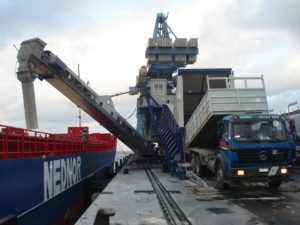
The Euroloader 16 has many advantages. Euromecc adopted the mobile version of the shiploader, which does not need any civil works. This version is more compact than the stationary model during parking configuration. In fact, it is possible to close the discharging channel on the machine edge, reducing its obstruction (18 m long x 7.1 m wide x 8.7 m high as maximum obstruction of parking configuration). Moreover, during the loading phase, the Euroloader approached the ships in the direction of travel of the dock. Therefore, the machinery does not impede the dock usability and it is able to easily move on and off the vessel. Once it has reached its relative position, it uses the radial movement of the discharging channel.
Technical details
The first model of the Euroloader 16 was developed to work with gypsum and wet ash, with a maximum size of 25 mm per part. There is a receiving hopper of around 30 m3, while the discharging capacity has been designed to reach the nominal flow rate of 400 tph, for a working time of 24 hours a day.
The main element of the machinery is an apron conveyor mounted below the receiving hopper. This has an extractor belt that is 2.8 m wide and is able to receive up to 400 m3/h, feeding the receiving hopper of 30 m3. Following this, there are two belts: the first one is necessary for the extraction of bulk materials and the second is related to loading on the ship. Both are able to process up to 400 m3/h, with belts that are 1 m wide. At the end of the conveyor belt there is a chute that is able to manage telescopic movement and angular rotations.
The self-supporting frame sustains the entire structure and allows it to be handled. The mobility is realised with dump trucks: there are two twin fixed wheel groups located on the rear of the wagon and two twin wheel groups installed on a bearing gear. Once the shiploader is stationed on the working or parking area, it has to be stabilised and levelled to the ground. The lifting and lowering of hydraulic cylinders is operated by buttons that are located near the group of wheels. In fact, during
these phases, wheels will not support the shiploader. The inclinometers mounted along the machinery’s axles allow levelling of the shiploader. The loading ramps and the power packs are pulled down when the machine is stabilised. Installation of a powered travel system that allows the user to move the shiploader by two joysticks, placed both on the control radio and the control panel, is optional. Powered travel is provided by a hydraulic system and self-braking reducers installed on every group of wheels. With this drive system, the empty shiploader can reach the maximum speed of 300 mph.
The same joysticks mentioned above are able to manage the machine functions. Using the joysticks it is possible to set the radial conveyor belt position and control its start and stop motions. Power supply can be provided
by a generator set close to the shiploader or by wall sockets disposed along the dock. The generator set will obviously provide better power than the sockets if the customer decides to install the powered travel system.
All these structures and elements are covered in order to guarantee an adequate pollution control system. Furthermore, the receiving hopper is protected with side panels that prevent dust emission.
Installation and commissioning
The installation and commissioning of the Euroloader 16 followed Enel’s requirements for a turnkey project. Following the manufacture of each component, Euromecc delivered the machinery alongside qualified technicians. All items were pre-assembled and pre-wired by the company in order to ensure a short installation time and accurate quality control. This was a very important aspect of the delivery and installation process, which made the check up, carried out by Enel inspectors, much easier.
Once the parts arrived onsite, the Euroloader was erected within 5 weeks. This includes the training time for Enel’s operators, who have reported a very good user experience with the machinery, finding it simple and easy to use. Euromecc is happy to have achieved its goal in fulfilling the customer’s expectations.

 +39 335 7156 777
 +39 335 7320 949
 +39 335 7151 919
 +39 335 6792 771
 +39 342 5439 331
 +49 6190 9376 550


